
Ego check: Thought leadership isn’t for you.
What it is, what it isn’t,
& whether you should do it
If you think you’re leading, but no one is following, you’re just taking a walk.
John Maxwell
Lots of companies think they’re thought leaders. Most of them are just taking a walk.
They’re yelling into the social media void, buying mentions from so-called influencers, and measuring KPIs that have nothing to do with leadership — or thoughts, for that matter.
Becoming a thought leader sounds great in theory, but the journey to get there is long, hard, and potentially expensive. Before you set out to become one, it’s time for some radical honesty. Is this even a realistic goal for your business?
To answer that, you need to know the truth about thought leadership: what it really is, how to do it, and what it takes to succeed.
What is thought leadership, really?
Thought leadership is rare because it requires two things that are generally difficult for a business to accomplish:
- Leadership, and
- Thoughts
Think about it:
Leadership is hard to achieve and measure. It’s not reach, impressions, or clicks. It’s influence, which is much more valuable and rare.
Thinking, too, is more difficult than it sounds.
In thought leadership, your thoughts are your platform – the things you can talk about passionately without ever losing steam, even when nobody is listening. But not just your personal passions. It’s the passions and ideas on which your company stands, and most companies struggle to define this.
Okay, so let’s put the pieces together to define thought leadership.
Thought leadership is the influence you hold in discussions related to your expertise and passions.
When you are a thought leader, these things happen:
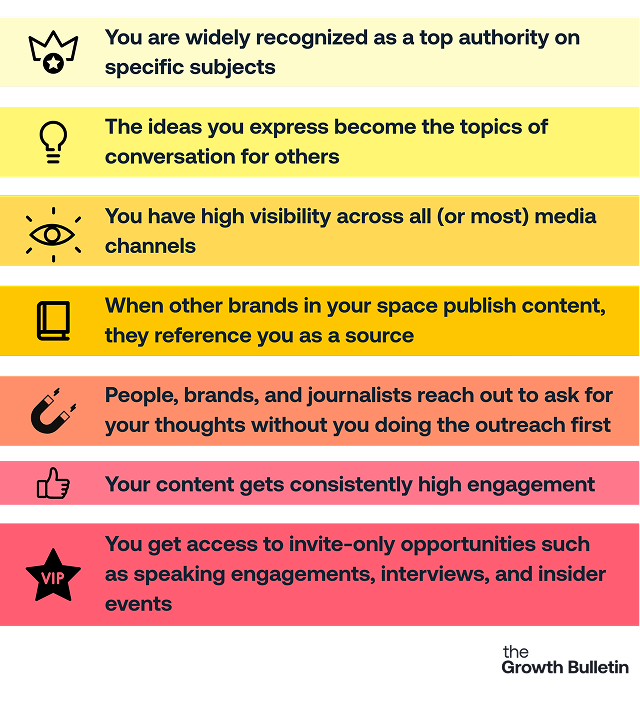
Do these look anything like your usual KPIs?
Probably not.
This is where confusion comes in for a lot of brands trying to launch their thought leadership strategy.
Since you measure success with things like mentions, backlinks, engagement rates, and inclusion in important events, companies think that increasing these metrics makes them thought leaders.
No amount of social media spend or SEO success will make you a thought leader.
Reach, engagement, and mentions are symptoms of thought leadership, not causes. They are indirect ways to measure your influence.
So many businesses are out there booking speaking engagements for their execs, pushing their marketing team to publish more guest posts, and missing the point of thought leadership entirely.
An effective thought leadership strategy must be anchored in building influence.
Advertisement

Longevity
Everyone knows: you don’t get rich with a salary.
You invest. Get compound interest. Maybe gamble a little and get lucky.
But hard work won’t get you there.
The same goes for customer acquisition.
You can throw money at ads. Man-hours at outreach. But real wealth?
A strong organic pipeline.
It works for you while you sleep.
Traffic quality is pristine.
Returns increase with every dime you put in.
Start playing with the world’s best SEO tools today, for free.
Your business will outlive you.

Let’s talk about thoughts
again
So, you want to be a thought leader.
What thoughts do you have that everyone else should be talking about?
Spoiler alert:
| “you should buy my product because it solves your problem”
…is not a thought leadership platform. It’s a value proposition, and while your sales team needs those, the wider world is never going to care.
Thought leaders have opinions. They have passion. Their voice has a reason to exist beyond selling a product or growing a company. It feels like the idea is what matters, and the company merely exists to further that idea.
And if that’s not you, that’s okay. You don’t have to be a thought leader to grow your company successfully.
But let’s assume that is you.
You have something to say, and that something matters. You feel strongly that everyone is missing the point in your field, or you’re compelled to call out practices you disagree with, or you know more than anyone in the world about your industry and you just can’t stop talking about it.
Your thought platform is the topic or idea you talk about all the time. It should be more specific than “anything in my industry,” but it doesn’t have to be a single idea.
The key is to be consistent enough that people intuitively know when an idea or story is in your wheelhouse. If you’ve got people tagging you in social media comments because they want to hear your take when someone else posts about your favorite topics, that’s a good sign.
Passion matters here
Your emotional investment is the thing that makes it possible to build influence with your thoughts. About 5% of the enthusiasm you feel will make it through to your audience. That 5% needs to still be enough to resonate.
Plus, you need to care enough that you constantly post and blog and comment about this thing, no matter the responses (or lack thereof) you get. If you’re not at least a little bit obsessed, you’ll run out of steam long before you ever build any influence.
What’s that thing for you?
If nothing comes to mind, honestly, you should probably drop your thought leadership aspirations now.
But if you’ve got a thought that absolutely lights your fire, you can move on to the next part: execution.
There are 2 kinds of thought leaders. You are the second one.
Thought leaders come from two places:
- They became thought leaders accidentally. They simply can’t shut up about the thing they’re obsessed with, and they’ve organically built their influence just by being themselves.
- They became thought leaders on purpose. They use their obsession as a strategy, and they do everything they can to maximize their charisma and reach to build their influence.
If you were the first type, you probably wouldn’t be reading this.
So for you who are here, let’s look at what it’s going to take you:
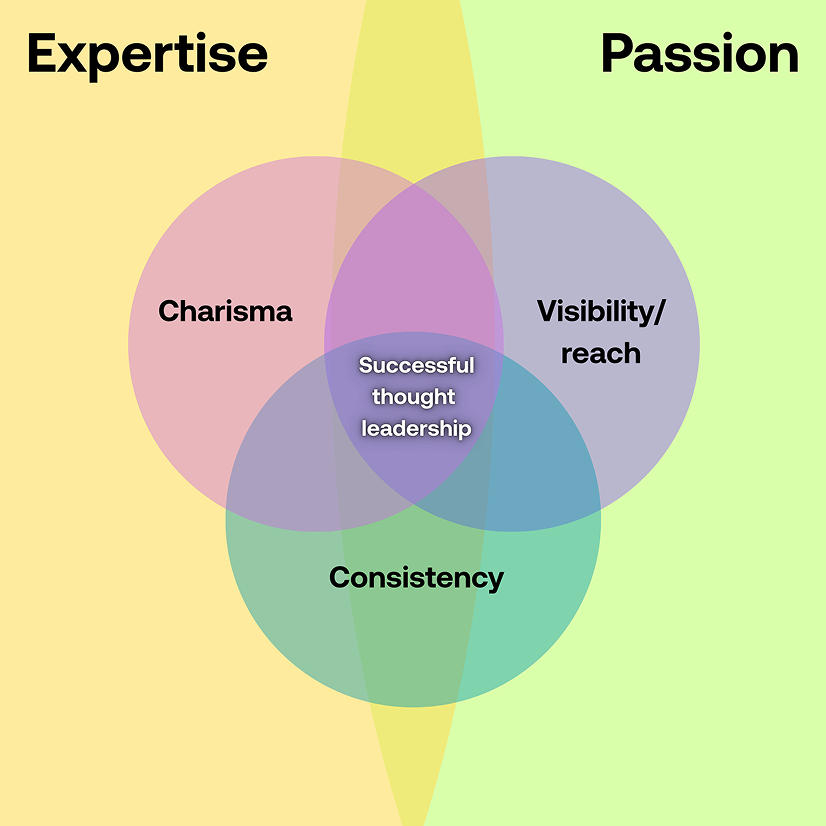
Passion and expertise, you’ve understood. But let’s talk a little about the next three elements.
Charisma: make them feel something
Did we say your thoughts and ideas matter?
They do, but maybe only half as much as how much you make people feel.
The best ideas delivered blandly will get nowhere.
Bad ideas with captivating delivery get somewhere.
If online charisma doesn’t come naturally, put more focus on leveraging emotion.
You can target any emotion that works for you, but some of the most powerful are:
- Anger
- Greed
- Desire
- Jealousy
- Fear
- Curiosity
- Loyalty and community
Just look at the news headlines to get an idea of which emotions are the most galvanizing.
Be cautious when you appeal to emotions like anger and fear, though. These are a lot like drugs: they hit hard at first and provoke strong responses, and you’re going to be tempted to lean hard into outrage-based content when your engagement skyrockets. But the shock wears off with repeated use, and you have to dial up the intensity as people become desensitized.
That’s why the internet is full of rage bait. If that’s your thing, go for it, but be aware that your more moderately expressed ideas will be far overshadowed.
Oh, and keep in mind that the entire world is not your audience.
If you want to be a thought leader to model train hobbyists, you don’t need to waste your effort trying to speak to people who don’t give a hoot about model trains. Hit the emotional triggers for other train nerds, and don’t worry about being interesting to the rest of the world.
Visibility: you can’t lead if there’s nobody around
You can’t influence if you’ve got no attention.
As your influence goes, your ability to get organic reach will grow, too. But until then, you’re going to have to figure out other ways to be seen.
This is different from your usual marketing strategy.
In marketing, you choose your channels and methods based on ROI. You focus your energy on platforms that measurably drive results, and you deprioritize the rest.
The early days of your thought leadership efforts can’t be driven by ROI, or you’ll never build your influence.
Your goal is entirely different. Rather than trying to get people to click, do, or buy something, you’re setting out to become part of the mental landscape. It’s more than brand recognition. It’s more than relationship-building. It’s literally influencing people’s thoughts.
Building thought leadership means you post on every social media platform, even when you don’t get engagement. Join and participate in every major community related to your platform, whether it’s on Discord, Reddit, or your competitor’s website. Go to conferences, book speaking engagements, appear on podcasts, and if there aren’t opportunities to show up to these things, create your own.
You have to be everywhere because it takes consistent, repeated exposure to your name and ideas to begin shaping other people’s thoughts.
If you build a huge following in one place while ignoring the wider world, that’s great — but it makes you a garden variety influencer, not a thought leader.
Consistency: can’t stop won’t stop
This final ingredient applies to both the frequency that you speak with and the topics that you speak about.
This is one of the reasons it’s so hard to become thought leader. You might know exactly what your platform is, and you have all the passion to express those thoughts boldly and charismatically.
But it’s not just you. You have company.
Your company is full of other people who have other ideas and passions. Keeping things consistent requires pretty constant oversight from a single person.
You all need to synergize for the thought leadership effort to thrive, but it opens you up to idea drift. As some comments, posts, or emotional hooks get results, your team will naturally want to do more of those things and less of the stuff that doesn’t seem to be generating a response. Personal biases will come into play. Over time, even if you started with a clear idea, the actual things that get shared with the world will move away from the thought you wanted to lead with.
A little adjustment over time is fine – we all learn and grow. But don’t chase engagement. Stay true to your core idea and consistent in your opinions, or you’ll never have the integrity to build real influence.
Why it’s (probably) not worth it
Are you considering thought leadership for the ROI?
Maybe you should consider some traditional marketing tactics instead.
Becoming a thought leader is a long game, but it’s not like SEO.
In SEO, use the right tools (like Semrush) and play your cards right, be consistent, and you’ll rank.
In thought leadership, success is based entirely on the way other people think of you, meaning it’s only partially in your control. Outside factors will always have a big impact on your success or failure.
Even if you do succeed, it doesn’t always translate to a financial benefit for your business.
Conversely, there are costs involved. You need a high volume of different types of content, and you need your thoughts expressed eloquently, and you need a lot of people to see the content you create. There’s a good chance you’re going to spend some money making these things happen, though you can do them yourself if you have the time.
Sidebar: It’s becoming increasingly common for businesses to hire freelancers to create “thought leadership content.”
The irony of outsourcing your thought leadership to a contractor who has no idea what you think is not lost on the content writers who take these jobs.
Sure, freelancers can create content that helps you become a thought leader.
But you have to provide the thoughts. Most of the time, businesses want the freelancer to figure out what they think, and that misses the point.
Food for thought
Why don’t companies express opinions more often? It’s because as often as someone agrees with you and wants to support your business, someone else disagrees with you and doesn’t want to support your business. Some companies are comfortable with controversy. Others aren’t.
And just because you are aligned with the prevailing opinions today, that doesn’t mean you’ll be popular tomorrow. Thought leadership might help your bottom line today and hurt it in 6 months as sentiments change.
Are you up for the challenge?
Now, you know more about thought leadership than any of those hundreds of companies who simply announced that they’re thought leaders without ever having an original thought.
Is it worth it to you?
For most business strategies, it’s easy to make a list of pros and cons, estimate your potential investment, and forecast an ROI.
You can’t do that reliably with thought leadership. There are too many unmeasurable factors to consider, and your motivations might not even be related to ROI.
In fact, the most successful thought leaders don’t do it for the returns at all. Perhaps that’s the secret: you should only set out to become a thought leader if your passion is more important than lining your pockets.
Ready for thought leadership?

About the author
Kitty Solbrig is a seasoned pro at marketing, content, and all kinds of growth strategy. She’s a marketing junkie whose obsession goes far beyond a full-time job. In her 14+ years working with entrepreneurs and brands, she has served as a mentor in startup growth incubators and on college campuses, led in-house marketing teams for successful tech startups, and built winning growth plans for companies in a variety of industries. As far as she’s concerned, she’s found her calling, and she’s grateful to support her growing family with a career that she loves
About the author
Kitty Solbrig is a seasoned pro at marketing, content, and all kinds of growth strategy. She’s a marketing junkie whose obsession goes far beyond a full-time job. In her 14+ years working with entrepreneurs and brands, she has served as a mentor in startup growth incubators and on college campuses, led in-house marketing teams for successful tech startups, and built winning growth plans for companies in a variety of industries. As far as she’s concerned, she’s found her calling, and she’s grateful to support her growing family with a career that she loves